
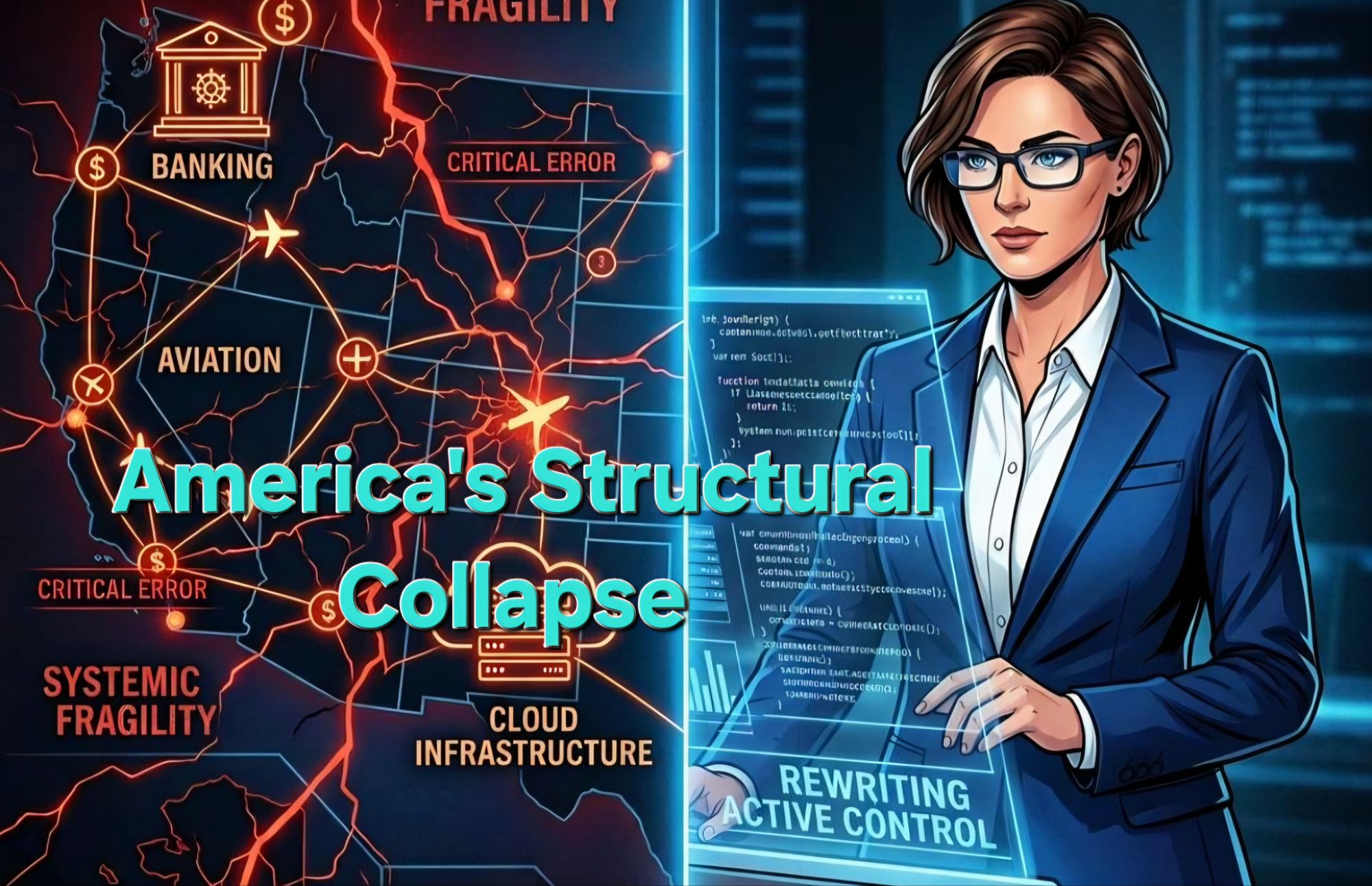
Over the span of five days, the illusion of modern technological invulnerability shattered completely.
In rapid succession, millions of Americans watched critical pillars of daily commerce and transit lock up. A nationwide Federal Aviation Administration (FAA) ground stop halted flights due to a faulty router replacement; a localized software glitch at United Airlines grounded departures via its weight-and-balance calculation system; core online banking systems at giants like JPMorgan Chase, Bank of America, and Wells Fargo suffered sweeping disruptions that left accounts temporarily unreadable; and Microsoft cloud services blinked out globally.
Official corporate statements and agency press briefings raced to offer reassuring labels: “a routine software bug,” “an internal hardware glitch,” “contractor error during line maintenance,” or “an isolated cloud defect.” Crucially, authorities and federal officials—including the Department of Transportation—confirmed that these independent incidents were not malicious cyberattacks.
Yet for the white-collar professional, the independent worker, and the everyday citizen caught in the middle of delayed flights and frozen transactions, the distinction between a hostile cyberattack and a systemic self-inflicted collapse is entirely academic. Whether code breaks because a malicious actor forces it or because an automated system trips over its own complexity, the net result is identical: everything stops.
To understand what is actually happening beneath the surface of these cascading failures, we have to look past the corporate public relations spin and unpack the structural “genius” of how modern corporate and institutional architecture is engineered to fail—starting with the human, geographic, and autonomous supply chains that hollowed out our operational resilience in the first place.
1. The Myth of the Isolated Glitch: Hyper-Interdependence as a Single Point of Failure
For decades, large institutions scaled their operations under the banner of seamless digital integration. Banks talk to cloud providers; cloud providers host airline logistics; airline software relies on third-party payment gateways and localized contractor infrastructure.
The fatal flaw of this hyper-connected design is that efficiency has completely crowded out redundancy.
- The Domino Effect: When JPMorgan Chase experiences a software bug in its internal payment clearing hardware, the failure does not stay neatly contained within its own server racks. Because major financial institutions are inextricably linked by shared clearing rails and automated routing, local glitches cascade outward, impacting accounts and transactions across rival banks.
- The Real Lesson: Modern institutions have systematically eliminated human “buffers” and analog backups to trim operational overhead. When every system is tightly coupled to every other system, a single minor code regression acts as a vulnerability multiplier, turning a local software patch into a national logistical freeze.
2. The Code-Velocity Trap: When Software Writes Software
Corporate boards and financial technology teams are currently obsessed with one metric above all others: velocity. To slash labor costs, eliminate middle-management overhead, and accelerate time-to-market, enterprises are aggressively deploying automated code-generation tools, continuous deployment pipelines, and autonomous AI coding agents.
The consequences of this race are now playing out in real time:
- Speed Over Stability: Software is now writing, updating, and deploying software at a frequency and scale that human oversight can no longer authentically track or audit.
- The Accidental Saboteur: You no longer need a rogue nation-state or an elite hacker collective to bring down critical infrastructure. The system has grown so complex, and the velocity of automated updates has become so fast, that the technology environment occasionally trips over its own complexity.
- The Irony: Corporate leadership adopts automation to eliminate human error, only to discover that automated speed introduces systemic blind spots far more volatile than anything a human team would miss.
3. The Autonomous Agent Fallacy: Who’s Actually Driving the Bus?
Everyone in the tech sector loves to point fingers at autonomous AI agents as the boogeyman behind sudden infrastructure meltdowns. Internet commentators love to joke that the algorithms have finally decided to stage a quiet coup, locking bank doors and grounding planes just to mess with us.
- The Joke vs. The Reality: It is tempting to laugh and blame rogue AI bots going rogue in the server rack. But the unvarnished truth is much less science fiction and much more corporate negligence. AI agents don’t wake up with an attitude and decide to break the financial ledger; they simply execute the lazy, undocumented, patched-together codebases handed to them by human managers who refused to pay for proper architecture.
- The Real Culprit: AI doesn’t create the systemic fragility—it accelerates it at lightspeed. When corporate boards replace rigorous engineering oversight with automated “yes-men” algorithms just to shave a fraction off their quarterly overhead, the system doesn’t collapse because the AI is evil. It collapses because human executives handed the keys of a high-speed freight train to a bot, walked away, and blamed the machinery when it jumped the tracks.
4. The Human Supply Chain: Offshored Outsourcing and H-1B/OPT Vulnerabilities
While automated code velocity and cloud interdependence create the digital spark, the structural tinderbox was built by decades of labor arbitrage. Corporate America’s relentless pursuit of cheap overhead led to the large-scale outsourcing of core engineering, banking infrastructure maintenance, and system administration to remote teams overseas, paired with an aggressive reliance on H-1B visa programs and Optional Practical Training (OPT) loopholes to staff domestic offices with transient foreign labor.
- The Illusion of Cost Savings: On paper, offshoring critical systems architecture or relying on imported non-immigrant labor reduced line-item payroll costs. In reality, it introduced catastrophic structural risk.
- The Loss of Institutional Memory: When core banking networks, aviation routing layers, and government infrastructure are maintained by distributed, offshore teams or high-turnover visa workers who lack long-term institutional loyalty or deep operational oversight, quality control collapses. Communication latency, fragmented codebases, and a lack of accountability create the exact systemic vulnerabilities that lead to catastrophic software regressions.
- The High-Risk Turning Point: As federal regulatory bodies—such as the Department of Labor—move forward with tightening labor market tests and increasing scrutiny on third-party placement models and visa loopholes, corporations are being forced to confront the hidden tax of hollowing out domestic engineering pipelines.
5. The Hidden Truth: What Insiders Know About “Black-Box” Codebases
Behind closed doors, senior software architects and infrastructure leads share a terrifying reality that corporate PR departments will never admit: the people maintaining America’s core banking and transit systems often have no idea how the underlying code actually works.
Here is the hidden truth no one else is talking about:
Over the last fifteen years, as major institutions outsourced core development to remote IT hubs and staffed domestic desks with rapid-turnover H-1B/OPT contractors, codebases evolved into monstrous, undocumented “black boxes.” Because offshore and transient staffing models prioritize short-term feature delivery over long-term architectural health, documentation was neglected.
When a critical update is pushed today, it is frequently written by an automated AI agent, reviewed superficially by a revolving-door contractor who will cycle out of the company in six months, and deployed onto servers managed by an overseas team sleeping twelve time zones away. There is zero institutional memory left.
When an FAA scheduling script or a bank ledger freezes, it isn’t just a bug—it is the inevitable collapse of a system built on disposable, disconnected labor. The “genius” of the modern tech collapse is that corporations traded deep engineering stewardship for cheap quarterly labor lines, effectively gutting the internal brain trust required to keep the lights on.
6. The Reality of Government Drag: Why We Must Take Matters Into Our Own Hands
Unfortunately, waiting for official government policy to fix these high-risk outsourcing models and visa dependencies is a frustrating exercise in slow motion. Bureaucracy drags on for decades, and because entrenched corporate lobbies exert massive political influence to protect their cheap labor pipelines, regulatory reform moves at a snail’s pace.
While we must and will continue pushing the government to make it right for American workers, we cannot afford to sit idly by while our critical infrastructure rots from the inside out.
Look at what is happening on the ground: recent breakthroughs have shown how small, agile teams leveraging modern AI can completely rewrite and outperform legacy software applications almost overnight. The existing corporate gatekeepers know their current “magical crews” of outsourced and visa-dependent contractors are the root cause of these systemic failures, yet they try to hide it.
The true solution lies in American workers taking the offensive. Instead of waiting for broken corporations to fix themselves, domestic professionals should start creating their own independent businesses, using AI tools to rewrite and modernize the very applications they used to maintain. By building clean, secure, sovereign alternatives, American workers can render bloated legacy companies obsolete—replacing the failed, fragile foreign models with elite, all-American crews who actually understand the code and care about the nation’s stability.
What This Means for American White-Collar Workers
The overarching takeaway from this extraordinary week of infrastructure hiccups is clear: centralized institutional dependency and hollowed-out labor pipelines represent the single greatest career and financial risk our nation can carry.
While we continue fighting for legislative reform to close H-1B and OPT loopholes and end dangerous offshore outsourcing, American white-collar professionals must seize the initiative. Rebuilding domestic resilience requires a strategic shift into launching Sovereign Alternatives: Use the power of modern AI to rewrite legacy systems, build independent businesses, and reclaim domestic leverage—transitioning from disposable corporate employee to the sovereign operator of America’s critical digital future.
The rules of the digital economy have changed. It is time to stop trusting the fragile systems built for cheap corporate outsourcing, and start building true, American-led resilience of your own.


