
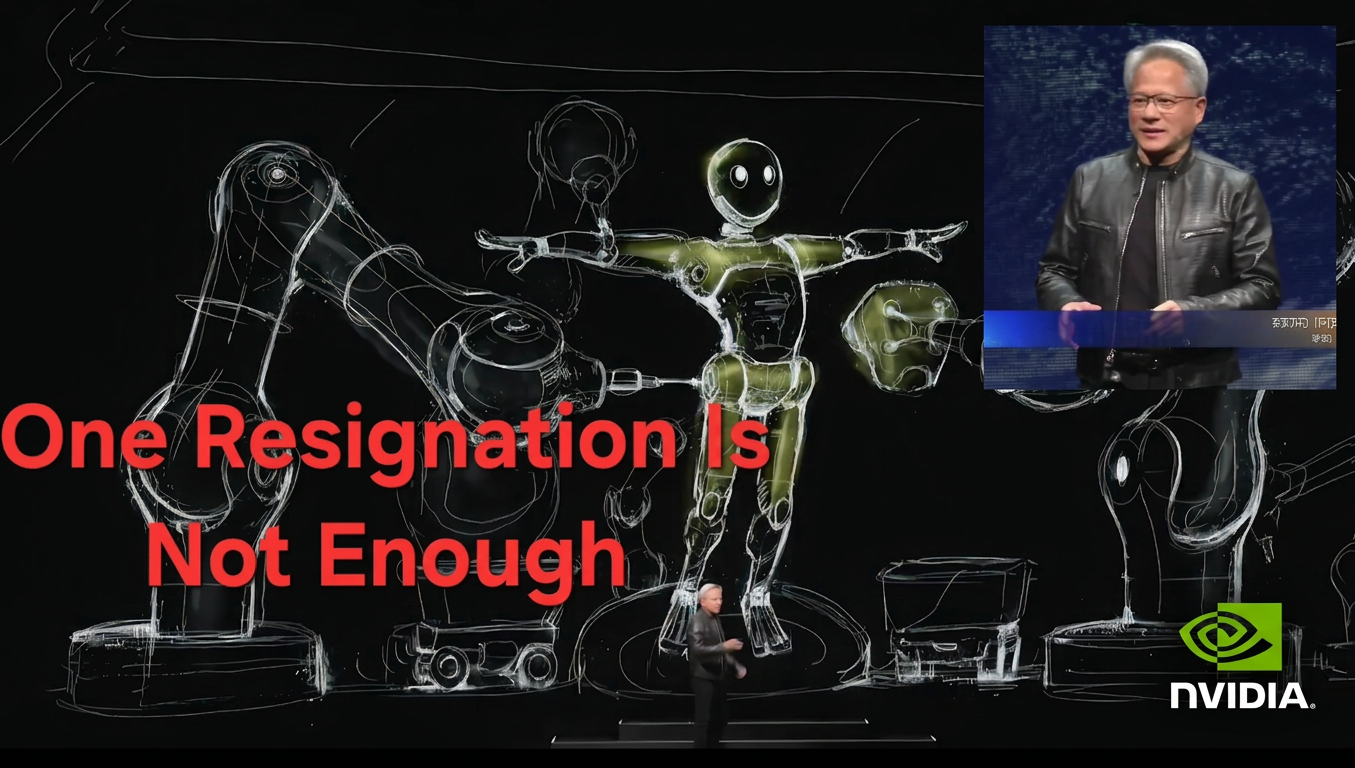
For three decades the American white-collar worker has lived under one set of rules while the people at the top lived under another. Workers can be erased in a morning meeting with no warning, no soft landing, and no public mourning. CEOs almost never are. On November 12 that asymmetry cracked, briefly and publicly, when Jensen Huang resigned as Nvidia’s chief executive with effectively no runway left.
The mainstream reaction has been predictable: elegies for the “godfather of AI,” hand-wringing about the future of the chip industry, and dark warnings about national security. Almost no one has said the obvious thing from the perspective of the people who actually build and staff these companies. For once, a CEO experienced something closer to the abruptness that regular Americans face every year. That is not a tragedy. It is a rare moment of clarity.
What the record actually shows at Nvidia
Strip away the leather jacket and the keynote theatrics. Nvidia’s labor record over the past fifteen to twenty years is clear. The company has been a heavy and accelerating user of the H-1B system and the green-card pipeline that follows it. In recent fiscal years it has filed for well over a thousand H-1B positions annually, ranking among the more aggressive tech sponsors, with median offered salaries in the high $180,000s. It has carried the formal designation of an H-1B-dependent employer. Thousands of foreign workers have entered its software, hardware, and research ranks through these programs.
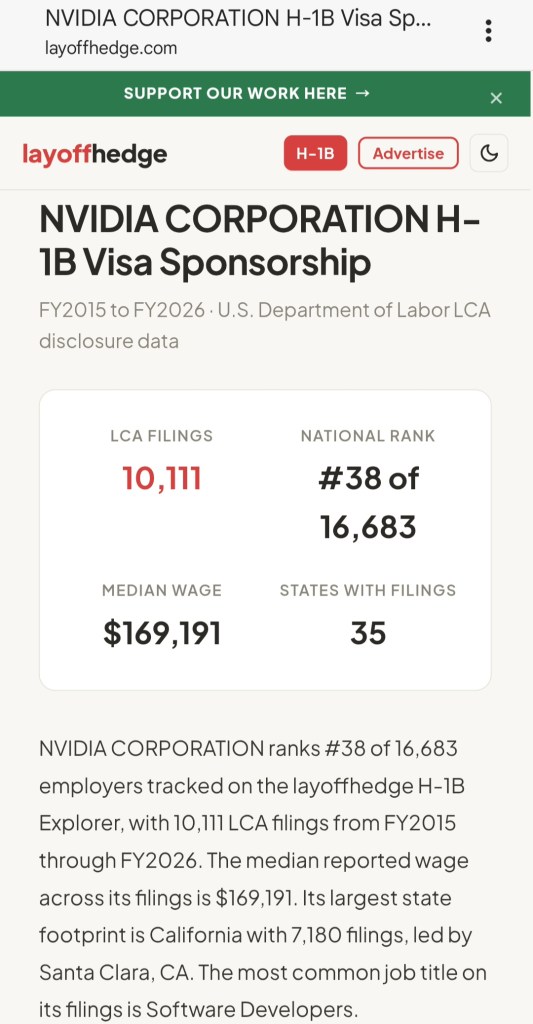
The question that almost never gets asked is the simplest one: what sustained, concrete program did Nvidia run to prioritize, train, or protect American engineers and white-collar workers at comparable scale? The public record shows the opposite priority—year after year of expanding the foreign labor supply in the same occupational categories where American workers compete. That long pattern, more than any single scandal, is what shaped the lived reality of many U.S. professionals in the industry.
Huang’s exit was sudden. That is precisely the point. Ordinary workers lose jobs with little or no warning. The fact that a CEO finally experienced a version of the same treatment is not cause for mourning. It is cause for noticing how rare the symmetry still is.
Know Your Client
Treasury Secretary Scott Bessent reminded everyone on Friday that forcing one man out does not clean the house. The real question is whether the company truly knew its clients and protected American interests.
Here is a simpler truth that almost never gets said out loud: when a company employs thousands of people in America, those American workers are its clients. They are an obligation. KYC—Know Your Client—should begin with the people whose livelihoods the company controls every day.
When a corporation is already busy neglecting and abusing that primary obligation—treating American workers as disposable while steadily replacing them—selling out to American adversaries is usually the next logical step. The same institutional muscle that looks the other way on the slow displacement of American brothers and sisters is the muscle that looks the other way on everything else. It has been a sturdy habit for 35 years: watch it happen, stay silent, keep doing it, normalize it until the whole country accepts it, and always demand more.
One resignation does not reverse that habit. The culture that produced it remains firmly in place. Accountability of this kind cannot stop at a single chief executive. It must reach the board level and the permanent executive class itself. Ordinary employees are rotated out every few years, sometimes every few months. Yet the same small circle of leaders is permitted to hold power for decades, insulated from the very instability they impose on everyone else. That double standard has no justification. The same rules must apply at the top. Moments like this should become more frequent, spread across more companies, and arrive with far less hesitation than they have until now. They should have begun years ago.
Microsoft: a different company, the same detachment
Microsoft is a separate case, and in some ways a more revealing one. Two weeks before the Nvidia announcement the company offered voluntary buyouts to roughly 60,000 employees—about a quarter of its global workforce. While those offers were still open, its Outlook, Teams, and Microsoft 365 services suffered a prolonged global outage that locked governments, airlines, businesses, and ordinary workers out of basic tools for hours.
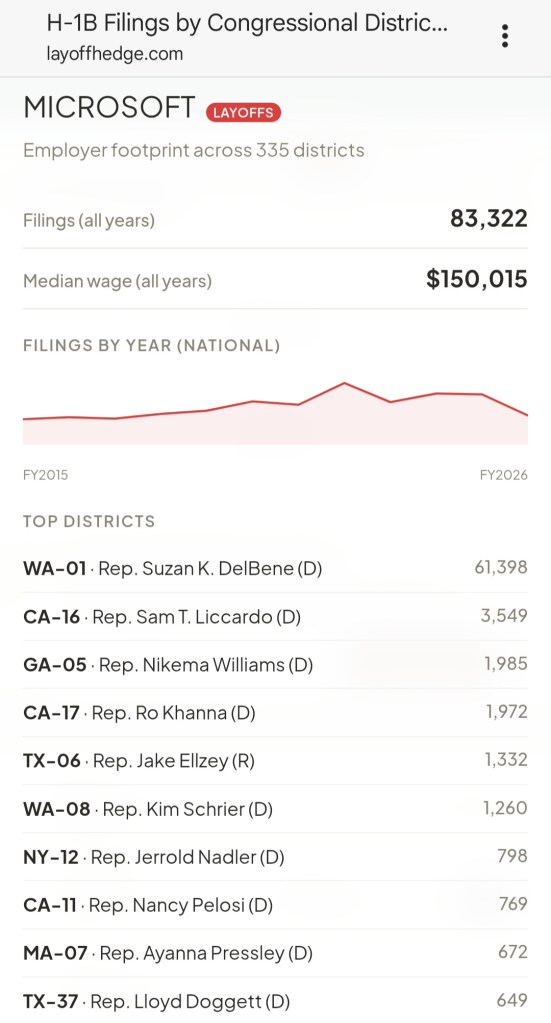
In an era when artificial intelligence is supposed to represent the peak of technological competence, a core productivity suite failing at this scale is not a minor glitch. It is a statement about priorities. Microsoft has long concentrated large portions of development and support in lower-cost locations. The product that results is the product customers experience. Free and more reliable alternatives have existed for years. The reason the company still dominates is not technological inevitability. It is habit and inertia on the part of the rest of us.
The larger pattern
Larry Ellison, Elon Musk, and the broader permanent executive class operate inside the same system. Boards that routinely approve heavy reliance on foreign labor programs while American workers absorb the volatility have delivered no unique public value that justifies their insulation. They have allowed a two-tier reality to harden: abrupt consequences for the rank and file, protection and soft landings for the people who set the rules.
The correct response is not conspiracy theories about hidden geopolitical forces. The correct response is simpler and more radical. The sudden removal of a CEO should no longer be treated as an unthinkable catastrophe. It should be treated as a normal accountability mechanism—the same one ordinary Americans already live under. Every CEO and every board that has participated in the current arrangement should look at Huang’s exit and feel a cold recognition: the rules can, in rare moments, still reach the top.
American jobs belong to Americans. The companies that list on American exchanges, enjoy American legal protections, and sell to American customers have an obligation that goes beyond quarterly earnings. When they forget it, the only language they appear to understand is consequence. For one night in November, consequence arrived. It should not be the last time.


