
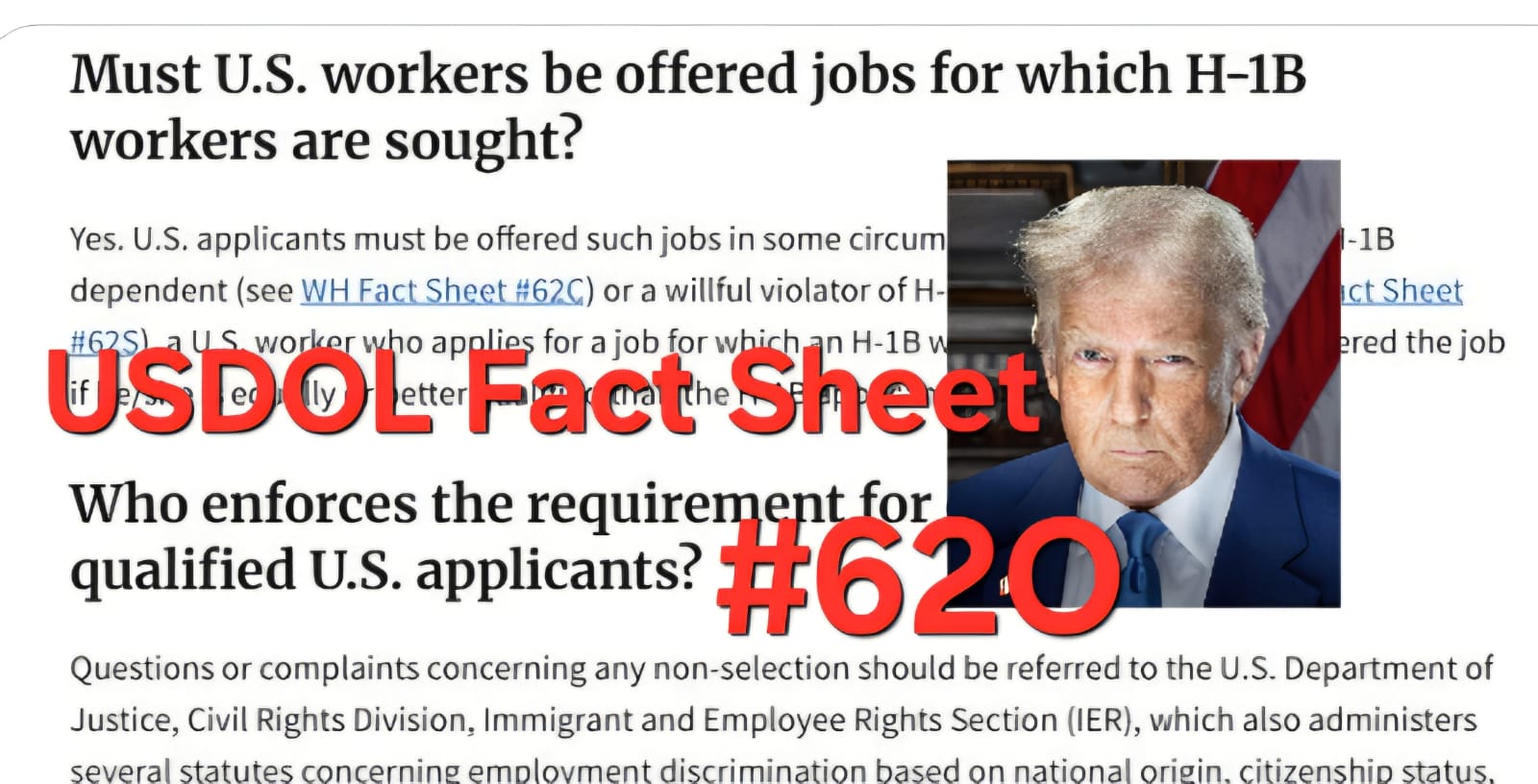
In January 2025, the U.S. Department of Labor (USDOL) updated Fact Sheet #62O, a policy aimed at prioritizing American workers in the H-1B visa program. While this change, initiated under President Trump’s administration, offers a promising framework to protect U.S. jobs, its impact remains limited—with 126,345 H-1B positions certified in FY 2025 Q2 (a 10.5% increase from FY 2024) and 424,261 H-1B, H-4, and L-1 visas approved in 2023. This article examines Fact Sheet #62O, acknowledges its potential as a step forward, but calls for stronger enforcement and broader action to truly put American workers first, while equipping them with AI-driven strategies to seize this opportunity.
Fact Sheet #62O: A Policy with Potential for American Workers
Fact Sheet #62O, updated in January 2025, marks an effort to address the displacement of American workers by the H-1B visa program. The policy requires H-1B-dependent employers—those with 15% or more of their workforce on H-1B visas, typically firms with over 50 employees—and willful violators of H-1B regulations to offer jobs to U.S. workers if they are equally or better qualified than H-1B applicants. This reversed the 2023 version, which allowed such employers to bypass Americans, often prioritizing cheaper foreign labor.
Under 20 CFR § 655 Subparts H & I, Fact Sheet #62O gives American workers at H-1B-dependent firms like Infosys (16,286 certifications) and Cognizant (12,784 certifications) a legal right to priority. For example, a U.S. software developer in Texas, where 14.5% of H-1B certifications (18,320 positions) were granted in FY 2025 Q2, should be chosen over an H-1B worker with the same qualifications. The policy, introduced during President Trump’s administration, reflects an intention to support American workers, but its effectiveness hinges on enforcement and broader systemic change.
The Current Landscape: Progress Stalled by Challenges
Despite Fact Sheet #62O’s potential, H-1B hiring remains robust, highlighting the need for more action:
- USDOL FY 2025 Q2 Report: The USDOL certified 126,345 H-1B positions from January to March 2025, a 10.5% increase from FY 2024. These visas dominate tech roles like Software Developers (36.2%, or 45,737 positions) and states like California (25.9%, or 32,723 positions). For FY 2026, 120,141 H-1B selections were announced, showing continued demand.
- Historical Approvals (2018–2023): A chart shared by @amandalouise416 on May 21, 2025, details H-1B, H-4, and L-1 visa approvals:
- 2018: 255,239 (India: 187,829, 73.6%; Other Countries: 67,410)
- 2019: 255,506 (India: 188,006, 73.5%; Other Countries: 67,500)
- 2020: 162,015 (India: 118,157, 72.9%; Other Countries: 43,858)
- 2021: 96,361 (India: 70,436, 73.1%; Other Countries: 25,925)
- 2022: 301,175 (India: 221,045, 73.4%; Other Countries: 80,130)
- 2023: 424,261 (India: 312,689, 73.7%; Other Countries: 111,572) India’s share averages 73.4%, with a 40.9% increase in total approvals from 2022 to 2023, driven by firms like Amazon (31,817 certifications) and Microsoft (14,181).
- Wage Dynamics: A 2024 Economic Policy Institute study notes H-1B workers are paid 10-15% less than Americans, but Fact Sheet #62O could help drive wages up by prioritizing U.S. talent—if enforced effectively.
Fact Sheet #62O hasn’t yet reduced H-1B numbers, largely because the FY 2025 Q2 certifications and FY 2026 selections reflect applications submitted before the January 2025 update (e.g., April 2024 for FY 2025). However, its limited scope and lack of enforcement continue to hinder progress.
Opportunities for American Workers: A Foundation to Build On
Fact Sheet #62O provides a framework for American workers to reclaim their jobs, offering tangible opportunities:
- A Right to Priority: American workers at H-1B-dependent firms now have a legal right to jobs if they match or exceed H-1B applicants’ qualifications, a step toward fairness in hiring.
- Potential Job Gains: If enforced, the rule could open thousands of jobs. A 10% shift to Americans at H-1B-dependent firms like Infosys and Cognizant could create significant opportunities for U.S. workers.
- Support from the EEOC: The EEOC’s February 19, 2025, announcement from Acting Chair Andrea Lucas adds momentum, promising to address anti-American bias. Lucas stated, “Unlawful bias against American workers… is a large-scale problem,” signaling growing federal awareness of the issue.
Why Progress Is Slow: Systemic Barriers Persist
While Fact Sheet #62O is a positive step, several challenges have limited its impact:
- Pre-Rule Applications: The FY 2025 Q2 certifications reflect applications submitted before the January 2025 rule change, and the FY 2026 selections, based on March 2025 registrations, also predate the rule’s implementation.
- Limited Scope: The rule only applies to H-1B-dependent employers, leaving non-dependent firms like Amazon and Microsoft unaffected. These firms drive much of the H-1B hiring.
- Enforcement Gaps: Employers may exploit the “equally or better qualified” criterion to favor H-1B workers. Peasant Biomass (@PeasantBiomass) on May 20, 2025, noted that Brian Pasternak, head of the Office of Foreign Labor Certification, “is not doing his job” in ensuring H-1B hires don’t displace Americans. As of May 21, 2025, no enforcement actions have been reported.
- Corporate Influence: Tech giants spent $150 million in 2024 lobbying to maintain H-1B caps (OpenSecrets.org, 2024). A Lonely Impulse Of Delight (@LonelyImpulse87) on May 20, 2025, stated, “Musk and other billionaires want H1B,” pointing to corporate pressure that has slowed broader reforms.
- Systemic Inaction: Guardian Eagle (@eagle_patriot21) on May 20, 2025, highlighted systemic bias, stating, “US tech industry hiring managers are mostly Indians. They create job positions in their country to hire their own kind instead of Americans!” This underscores the need for more comprehensive action beyond Fact Sheet #62O.
While the policy is a step in the right direction, the Trump administration’s broader approach to H-1B reform has been inconsistent. Despite campaign promises to prioritize American workers, the continued growth of H-1B visas suggests that more decisive action is needed to fulfill this commitment.
Empowering American Workers: Strategies to Leverage Fact Sheet #62O
American workers can build on Fact Sheet #62O by taking proactive steps to secure their jobs. Here are practical strategies, enhanced with AI tools, to make the most of this opportunity:
- Optimize Applications with AI: Use tools like Jobscan or Resunate to align your resume with H-1B job postings, ensuring you meet the “equally or better qualified” criterion under 20 CFR § 655 Subparts H & I.
- File with IER: If you’re overlooked for a job at an H-1B-dependent firm, file a complaint with the Immigrant and Employee Rights Section (IER) at 1-800-255-7688 or https://www.justice.gov/crt/immigrant-and-employee-rights-section. Include your AI-optimized resume, the job posting, your application, and any rejection notice.
- Report to USDOL: Submit violations to the Wage and Hour Division via Form WH-4 at https://www.dol.gov/agencies/whd or call 1-866-487-9243. Use ChatGPT to draft a clear, professional complaint letter.
- Tip USCIS: Report H-1B fraud, such as “benching” (not paying H-1B workers while they wait for projects), at https://www.uscis.gov/report-fraud to prompt investigations.
- Engage ICE: Report systemic violations to ICE at 1-866-347-2423 or https://www.ice.gov/webform/ice-tip-form to combat labor exploitation.
- Research Your Rights: Use AI-powered platforms like Casetext to learn about your rights under 20 CFR § 655 Subparts H & I, empowering you to advocate for yourself.
- Target H-1B-Dependent Firms: Use Glassdoor and LinkedIn data to identify H-1B-dependent employers like Infosys and Cognizant, focusing your applications on these firms where the rule applies.
The Bigger Picture: A Call for Stronger Action
Fact Sheet #62O is a step toward fairness, but the H-1B program’s scale—424,261 approvals in 2023, with India’s 73.7% share—remains a challenge. With 1.5 million U.S. STEM graduates annually (National Science Foundation, 2024), American talent is ready to fill these roles, debunking the “skills gap” myth. The policy’s impact may grow in future data (FY 2025 Q3/Q4), but broader reforms are needed to address non-dependent firms and systemic biases.
The Trump administration deserves credit for initiating Fact Sheet #62O, a policy that aligns with the promise to prioritize American workers. However, the continued growth of H-1B visas and lack of enforcement show that this promise remains unfulfilled. American workers need more than incremental steps—they need comprehensive action to ensure every job goes to U.S. talent.
Take Action: Push for the Full Promise of Fact Sheet #62O
Fact Sheet #62O, alongside the May 19, 2025, visa ban on Indian travel agencies, offers a starting point for change, but the 126,345 certifications in FY 2025 Q2 and 424,261 approvals in 2023 show the fight is far from over. American workers must:
- Call for broader reforms to end H-1B, L1, J1, OPT, and H4EAD visas by contacting your representatives.
- Report violations to ensure Fact Sheet #62O is enforced.
- White-Collar Workers of America: Stand United.
Fact Sheet #62O is a foundation to build on, but American workers deserve the full realization of a system that puts U.S. jobs first—let’s make it happen.

 White-Collar Workers of America