
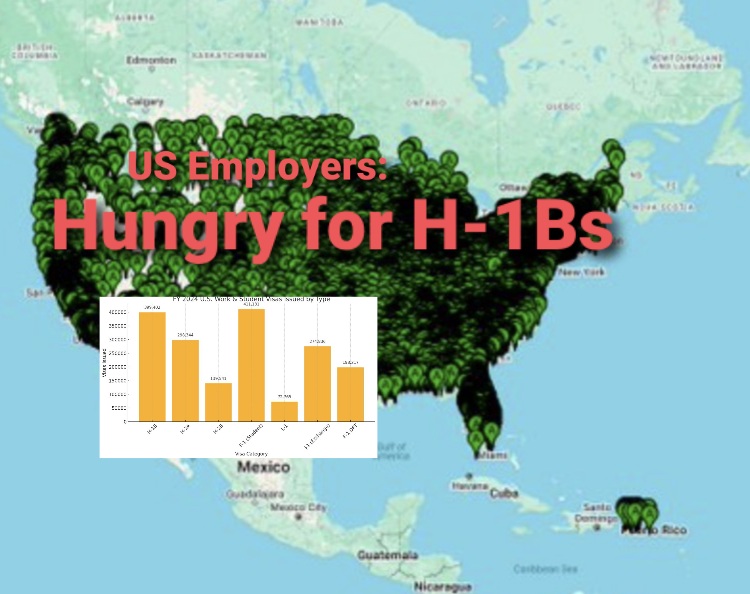
Picture this: American computer science graduates, raised and educated here, are ready to work—but 399,402 H-1B visas were handed out last year to foreign workers, taking jobs that should have been theirs. Now imagine a map with 780,884 dots, each one a company’s attempt to hire even more foreign labor in 2025, leaving millions of Americans jobless. Here’s the outrage: Indian applicants secured a 2:1 ratio for American corporate jobs, while companies turned USCIS into their personal recruitment office, bypassing Americans entirely! At White-Collar Workers of America, we’re exposing the H-1B lottery’s devastating impact and the systemic bias that favors foreign applicants over our own workers. We’re digging into the data, uncovering corporate and government secrets, and demanding justice for every American sidelined by this unfair system.
American Dreams Deferred: The H-1B Lottery’s Toll on U.S. Workers
American computer science graduates from 2024 are ready to launch their careers, but most of them are still jobless, their dreams are on hold. Why? Because companies would rather hire foreign workers through the H-1B lottery than give Americans a chance. On April 24, 2025, @VBierschwale shared a map revealing 780,884 H-1B lottery registrations for FY 2025—780,884 attempts to hire foreign workers while millions of Americans remain unemployed.
The H-1B program is supposed to help companies fill specialty roles when no Americans are available, but the data tells a different story. In FY 2024, 399,402 H-1B visas were issued, far exceeding the annual cap of 85,000 (65,000 regular + 20,000 for advanced degrees). As @ChiefNiftyswell warns, “Visa caps? They’re mostly theater now. Policy loopholes and quiet reforms have rendered them meaningless.” Historically, 72% of H-1B approvals go to Indian nationals (USCIS, 2023), meaning most of those 399,402 visas likely went to Indian workers, not Americans. This isn’t a skills gap—it’s a betrayal of American workers.
Decoding the H-1B Lottery Map: A Visual of Corporate Greed
The map shared by @VBierschwale is a stark visual of how companies prioritize foreign labor over Americans, but let’s break it down to understand its true meaning:
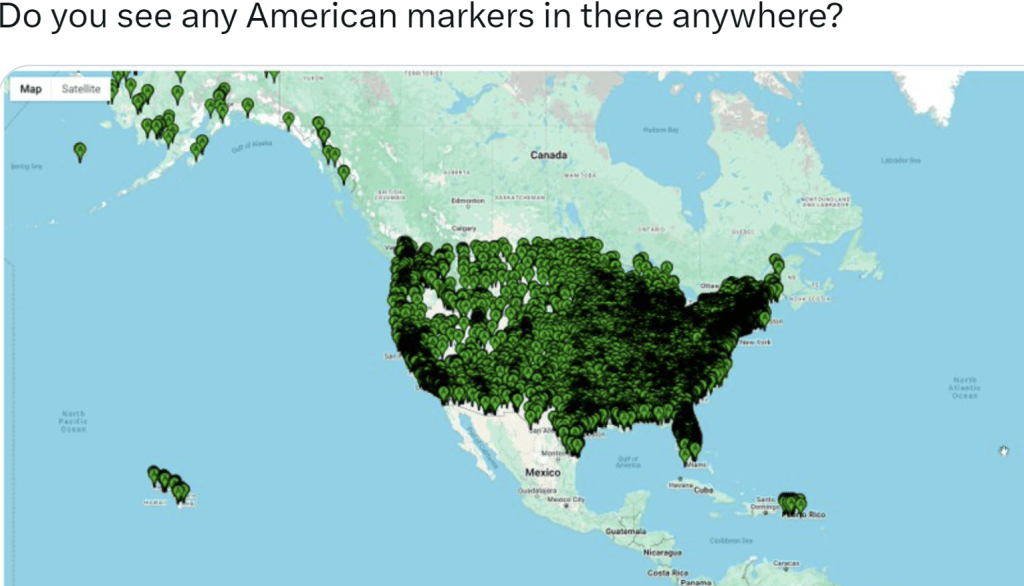
- What You See: Each dot represents one of the 780,884 H-1B lottery registrations for FY 2025, color-coded by state. California leads with 223,211 registrations, followed by Texas with 102,982.
- What It Means: These registrations are entries submitted by employers to the H-1B lottery, hoping to secure visas for foreign workers. The massive number—780,884—shows the overwhelming demand for foreign labor, even when millions of Americans are unemployed.
- The Hidden Truth: Not all registrations lead to visas, but the scale reveals corporate hunger and priorities. With tech hubs like California and Texas dominating, it’s clear that industries where American graduates are qualified are the same ones flooding the lottery with foreign labor requests.
This map isn’t just numbers—it’s a visual indictment of a system that lets companies ignore American talent while chasing cheaper foreign workers, who earn less than Americans for the same roles (Dice, 2024).
A Flood of Foreign Labor: 1.8 Million Visas in 2024
The H-1B lottery is part of a larger crisis. Data shows that in FY 2024, 1,794,236 work and student visas were issued: 399,402 H-1B, 298,344 H-2A (agricultural), 139,541 H-2B (non-agricultural), 411,131 F-1 (student), 72,765 L-1 (intra-company transferees), 274,836 J-1 (exchange), and 198,217 F-1 OPT (post-graduation training). That’s 1.8 million foreign workers and students entering the U.S. in one year, competing with Americans for jobs. The H-1B figure—399,402—alone shatters the 85,000 cap, exposing a system that prioritizes foreign labor over the millions of unemployed Americans.

Did Companies Seek Americans First? The Data Says No
Companies aren’t required to post jobs to seek Americans first for H-1B petitions. They must file a Labor Condition Application (LCA) with the DOL, attesting they’ll pay H-1B workers the prevailing wage or the actual wage paid to similar U.S. workers, whichever is higher, but there’s no mandate to prove they tried hiring Americans. Unlike the PERM process for green cards, the H-1B program lets companies bypass U.S. workers without consequence.
Did the employers behind the 780,884 registrations post equivalent jobs for Americans? There’s no evidence they did. The sheer volume of registrations suggests companies prioritized foreign labor. With 1 in 4 computer science grads jobless, qualified Americans are available—but they’re being overlooked.
Who Got the Jobs? A 2:1 Ratio for Indians, None for Americans
The 780,884 registrations for FY 2025 reflect the scale of foreign labor demand, and the 399,402 H-1B visas issued in FY 2024 show how many were actually granted. Let’s break this down: the 780,884 registrations likely include duplicates, as companies historically submitted multiple entries per beneficiary. Estimating a 25% duplicate rate, that’s approximately 585,663 unique beneficiaries. In 2024, 72% of the 399,402 H-1B visas went to Indian nationals (USCIS, 2023), totaling 287,569 Indian recipients (399,402 × 0.72). That’s a 2:1 ratio—585,663 unique beneficiaries to 287,569 Indian visas—meaning for every 2 applicants, 1 Indian worker secured an American corporate job.
Meanwhile, Americans raised and educated here got nothing—no jobs, no opportunities, just unemployment. In 2022, top H-1B employers like Amazon, Cognizant, and TCS hired 34,000 new H-1B workers while laying off 85,000, many of whom were Americans replaced by cheaper foreign labor. There’s no data on what jobs Americans got instead, but with millions of unemployed and most tech grads jobless, many are likely underemployed or stuck in gig jobs, unable to secure the specialty roles H-1B workers filled.
Is This System Fair? A Resounding No
Let’s call it what it is: the H-1B lottery system is profoundly unfair to American workers. A 2:1 ratio means nearly half of the unique beneficiaries—mostly Indian nationals—secured high-paying corporate jobs, while millions of Americans remain unemployed and none of computer science grads can’t find work. The system doesn’t require companies to prove they sought Americans first, and loopholes allow visa issuances to exceed the 85,000 cap by nearly fivefold (399,402 in 2024). This isn’t about a lack of talent—it’s about a system designed to prioritize foreign labor over our own. Indian applicants get a 2:1 shot at corporate jobs, while Americans are shut out. This isn’t fairness—it’s a rigged game, and American workers are losing.
USCIS as a Recruitment Office: Companies Bypass Americans
Here’s the dirty truth: companies have turned USCIS into their personal recruitment office. Instead of hiring Americans, HR departments submit 780,884 registrations to USCIS, effectively outsourcing their hiring to the government agency, which then facilitates the entry of 399,402 foreign workers in 2024 alone. They don’t post jobs for Americans—they recruit directly through USCIS, bypassing the millions of unemployed and jobless tech grads. The H-1B lottery has become a pipeline for foreign labor, with a 2:1 success rate for Indian applicants, while American workers are left out in the cold. This isn’t hiring—it’s a betrayal of the American workforce.
The U.S.-India MOU: A Government Loophole
The H-1B crisis is worsened by the U.S.-India Labor Cooperation MOU, signed in 2011. As @amandalouise416 highlighted on April 25, 2025, this MOU lacks enforcement for American workers, allowing companies to exploit it to hire Indian labor. The DOL, which oversees the MOU, fails to hold employers accountable, enabling the H-1B lottery to prioritize foreign workers over Americans.
Corporate and Government Secrets Exposed
The H-1B lottery thrives on hidden practices:
- Corporate Greed: Companies like Cognizant and TCS flood the lottery with registrations—780,884 in 2025—to secure foreign workers, achieving a 2:1 success rate for Indian applicants while laying off thousands of Americans in 2022–2023.
- Government Failure: USCIS and the DOL don’t require a market test for H-1B petitions, and the U.S.-India MOU’s lack of enforcement lets companies use USCIS as a recruitment office, ignoring the 4.3 million unemployed Americans.
A Call to Action: End the H-1B Lottery and Send Foreign Workers Home—Americans Need Jobs to Survive!
We’re in a dire economic crisis— Millions of Americans are unemployed, and tech grads can’t find work, struggling to survive while companies use USCIS as a recruitment office to hire 399,402 foreign workers in 2024 alone. The H-1B lottery, with 780,884 registrations, is a direct assault on the American Dream. In this economy, we shouldn’t have an H-1B lottery at all—it’s a luxury we can’t afford when Americans are fighting for their livelihoods! We demand President Trump take immediate, decisive action:
- Shut Down the H-1B Lottery Immediately: No more registrations, no more visas—American jobs must go to Americans first. The 780,884 registrations are a slap in the face to the millions of unemployed!
- Deport All Current H-1B Holders Now: With 600,000 H-1B workers in the U.S., we can’t let them stay while Americans go hungry. Send them back and let American workers fill those jobs to survive!
- End the U.S.-India MOU and Stop Corporate Abuse: Terminate this agreement that enables foreign hiring, and hold companies accountable for turning USCIS into a recruitment office.
President Trump, you ran on “America First”—now deliver! End the H-1B lottery, deport foreign workers, and give Americans the jobs we need to survive. We’re fighting for our lives—act now, or history will judge you as the leader who let the American Dream die!
A Future Where American Dreams Thrive
At White-Collar Workers of America, we’re heartbroken that 780,884 H-1B registrations and 399,402 visas issued in 2024 left millions of Americans jobless while companies used USCIS as a recruitment office to hire Indian workers. By exposing the H-1B lottery’s unfairness and demanding action, we’re building a future where American dreams thrive. Together, we’ll stop this betrayal and reclaim our jobs. The fight for American workers is on—and we won’t stop until we win!

 White-Collar Workers of America