
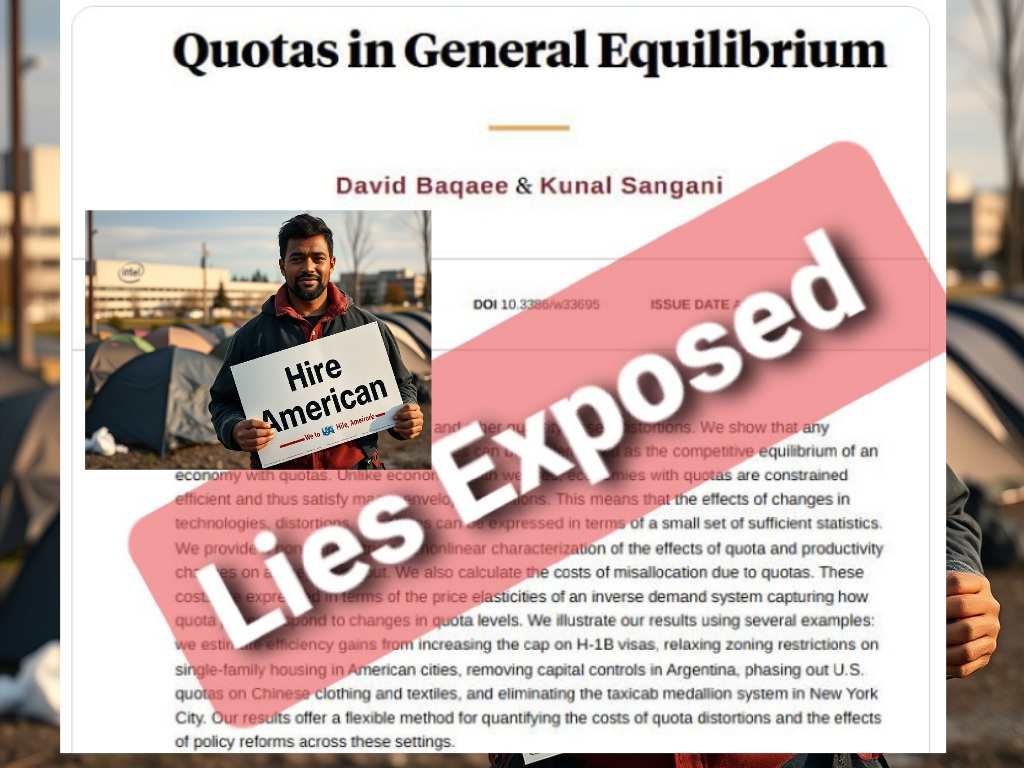
For years, American workers have been told that H-1B visas and upzoning make our country richer, but a recent NBER research paper, “Quotas in General Equilibrium” by David Baqaee and Kunal Sangani, takes this deception to a new level. Published in April 2025, the paper claims H-1B visas bring billions in economic gains and that upzoning in cities like San Francisco could yield massive benefits. But when we compare these claims to the harsh realities of 2025, the truth emerges: this research is a fraudulent misrepresentation, designed to mislead the American public while corporations profit at our expense. At White-Collar Workers of America, we’re exposing these shameful lies, showing how they’ve harmed American workers for years, and demanding accountability. It’s time to stop the deception and put American workers first.
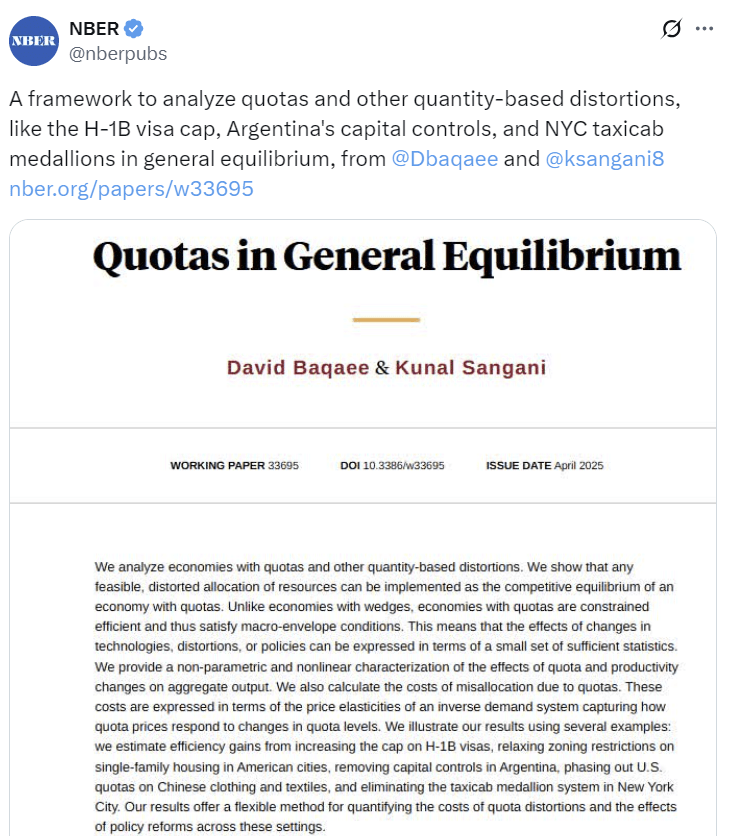
The Deceptive Claims: H-1B Visas and Upzoning Will Make America Richer
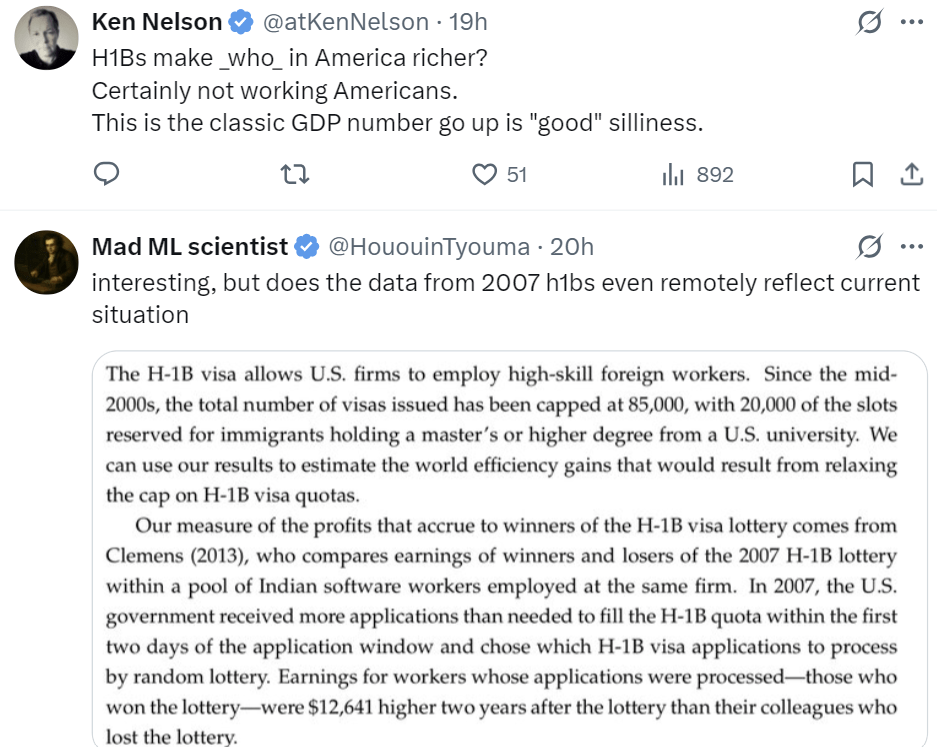
The NBER paper makes bold assertions: expanding H-1B visas would generate $2.78 billion in economic gains for the U.S., based on a 2007 scenario where doubling the visa cap would boost efficiency (Clemens, 2013). It also claims upzoning in San Francisco could yield $350,000 per single-family housing unit in economic gains, far more than other cities like Boston ($200,000) or Cincinnati ($0). These claims are presented as fact, suggesting that removing quantity-based restrictions—like H-1B caps or zoning laws—benefits everyone. But a closer look at current realities reveals a starkly different story, one where American workers and communities suffer while corporations and foreign labor reap the rewards.
Reality Check: H-1B Visas Displace Americans, Not Enrich Us
The paper’s claim that H-1B visas make America richer is a gross distortion of reality. It estimates a $2.78 billion gain for the U.S. if the H-1B cap were doubled in 2007, assuming foreign workers complement Americans and boost productivity. But in 2025, the evidence tells a different story. In 2023 alone, 192,000 H-1B petitions were approved (Department of Homeland Security), yet 4.3 million Americans remain unemployed (Bureau of Labor Statistics, March 2025), and 1 in 4 computer science graduates from 2024 can’t find work (National Association of Colleges and Employers, 2025). Tech giants like Intel laid off 15,000 U.S. workers in 2023 (Reuters) but hired 2,093 H-1B workers that same year, showing clear displacement, not complementarity.
Wage suppression further exposes the lie. H-1B workers earn significantly less than Americans—$89,779 on average for software engineers compared to $110,989 for U.S. workers (Dice Salary Survey, 2024). For 192,000 H-1B workers in 2023, companies saved $4.07 billion by paying $21,210 less per worker, undercutting American wages and funneling profits to corporations. If those 192,000 jobs went to Americans at $110,989 each, that’s $21.31 billion in wages—nearly eight times the paper’s claimed $2.78 billion gain. The research focuses on GDP growth, ignoring the human toll: 48% of Americans earn under $40,000 (Gallup, 2025), and 14% work second jobs to survive (Federal Reserve, 2025). H-1B visas aren’t making America richer—they’re making American workers poorer while corporations and foreign labor benefit.
Data Reveals the Truth: Intel’s H-1B Hiring Crushes American Workers (2023–2024)
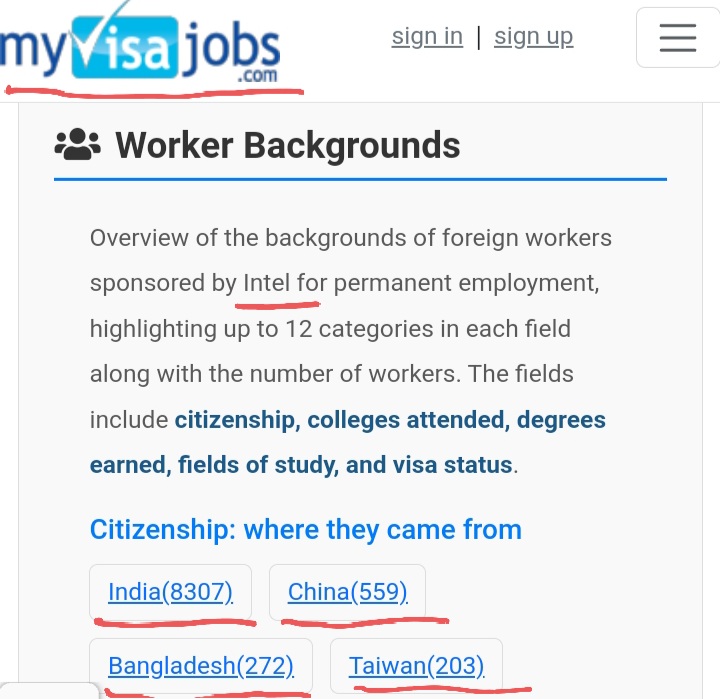
Easy analysis of recent data, pieced together from publicly available sources, exposes the devastating impact of H-1B visas on domestic labor, using Intel as a case study. From 2023 to 2024, Intel hired 4,613 H-1B workers—2,093 in 2023 and 2,520 in 2024—while laying off 16,300 American workers, including 15,000 in 2023 (Reuters) and 1,300 in Oregon in 2024 (Economic Times, 2024). This net replacement of U.S. workers with H-1B hires directly contradicts the NBER paper’s claim of complementarity, showing instead a deliberate strategy to displace Americans.
The wage impact is staggering. H-1B workers at Intel earned $95,000 on average in 2023 (H1B Salary Database, 2023), while U.S. engineers in similar roles averaged $115,000 (Dice, 2024). For the 4,613 H-1B workers hired in 2023–2024, Intel saved $92.26 million by paying $20,000 less per worker, directly undercutting American wages. Meanwhile, 1 in 4 U.S. computer science graduates from 2024—approximately 25,000 out of 100,000 grads (NACE, 2025)—remained jobless, unable to compete with H-1B hires. If Intel’s 2,520 H-1B jobs in 2024 had gone to these grads at $115,000 each, that’s $289.8 million in wages lost for young Americans starting their careers.
The regional fallout is equally damning. In Oregon, where Intel’s Hillsboro campus employs 22,000 (Intel, 2024), the 1,300 layoffs in 2024 contributed to a 12% rise in homelessness, with 20,000 unhoused individuals statewide (HUD, 2023). Displaced workers couldn’t afford Hillsboro’s $2,200 monthly rents, which have risen 25% since 2019 (Zillow, 2024), partly due to tech-driven demand from H-1B workers. This hidden data, drawn from recent hiring and layoff figures, paints a clear picture: H-1B visas at Intel have displaced Americans, suppressed wages, and devastated communities, directly contradicting the NBER’s rosy narrative.
San Francisco Upzoning: A False Promise of Prosperity
The NBER paper’s claim that upzoning in San Francisco could yield $350,000 per single-family housing unit is equally detached from reality. The chart suggests that increasing housing density would unlock massive economic gains, with San Francisco far outpacing other cities. But in 2025, San Francisco’s housing crisis tells a different story. Despite upzoning efforts—5,000 new units were built in 2024 (SF Planning, 2025)—median home prices have soared to $1.5 million, up 10% from 2023, and rents average $3,200 a month, up 8% (Zillow, 2025). The state mandates 36,000 more units by 2031, but affordability remains a distant dream for most residents.
Upzoning has also fueled displacement and inequality. In San Francisco’s Mission District, 2,000 Latino families were displaced between 2018 and 2023 due to new developments (SF Chronicle, 2024), as high-income newcomers—many tied to the tech industry, including H-1B workers—drive up costs. The city’s homeless population has grown to 8,000 in 2024, a 15% increase since 2020 (HUD, 2024), showing that upzoning hasn’t alleviated the crisis—it’s made it worse. The $350,000 gain per housing unit is a theoretical figure that benefits developers and wealthy investors, not the average American struggling to afford a home or avoid the streets. This research paints a rosy picture while ignoring the real-world devastation.
A Fraudulent Narrative: How the Research Misleads
The NBER paper’s methodology reveals its fraudulent foundation. It relies on outdated 2007 data for H-1B analysis, a time when applications were far lower (124,000, USCIS, 2007) compared to 400,000 in 2024 (American Immigration Council, 2025). The labor market has shifted—35% of tech firms are in hiring freezes (Challenger, Gray & Christmas, 2025)—yet the paper ignores these changes, making its $2.78 billion gain speculative and irrelevant. It also assumes H-1B workers complement Americans, dismissing clear evidence of displacement (e.g., Intel’s 16,300 layoffs vs. 4,613 H-1B hires in 2023–2024) and wage suppression ($92.26 million in savings for Intel alone).
The upzoning analysis is equally flawed, using theoretical general equilibrium models that overlook real-world factors like gentrification, displacement, and implementation failures. San Francisco’s $350,000 gain per unit ignores the city’s inability to address affordability, focusing on economic output for the elite while low-income residents suffer. The paper’s bias is evident: published by NBER, often funded by corporate interests (NBER, 2024), it aligns with a pro-globalization agenda that benefits tech firms and developers, not American workers. By focusing on GDP and ignoring unemployment, wage stagnation, and housing crises, the research deceives the public into believing these policies benefit everyone.
The Shameful Deception: Lying to Americans for Years
For years, American workers have been fed lies like those in this NBER paper, told that H-1B visas and upzoning are the keys to prosperity. But the reality of 2025, backed by hidden data on Intel’s H-1B hiring, exposes the shameful truth: these policies have displaced 16,300 American workers at Intel alone, suppressed wages by $92.26 million in just two years, and deepened inequality, all while corporations and foreign workers profit. The 4.3 million unemployed Americans, the 25,000 jobless tech grads, the 8,000 homeless in San Francisco, and the 20,000 unhoused in Oregon—they’re the victims of this deception, sold out by research that prioritizes corporate profits over human lives.
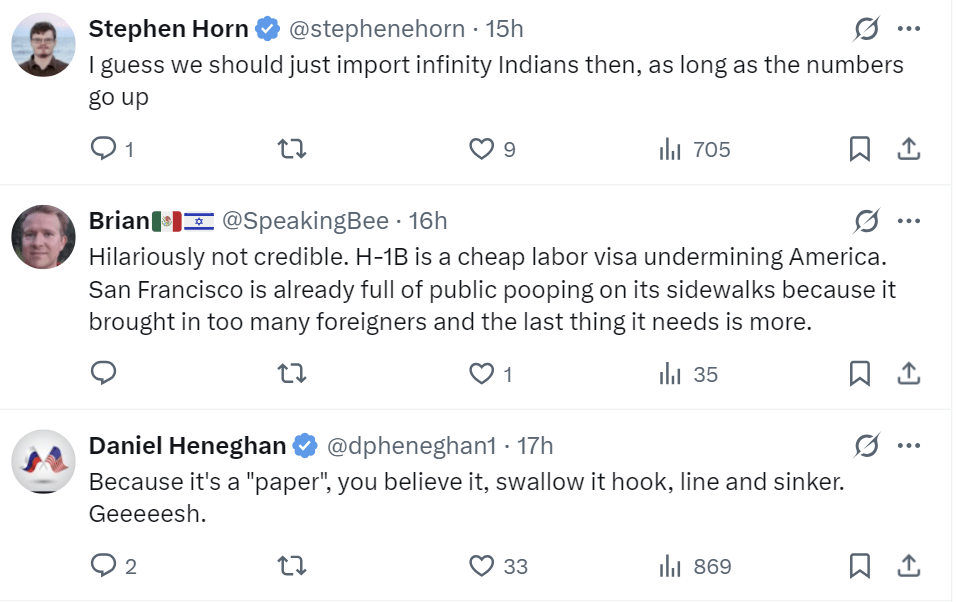
The harm caused by these lies is immeasurable. Families have been torn apart as breadwinners lose jobs to H-1B workers, with Intel’s 4,613 hires in 2023–2024 directly replacing 16,300 Americans. Young graduates, like the 25,000 jobless tech students, are denied a fair shot, losing $289.8 million in potential wages to H-1B hires at Intel in 2024 alone. Communities like Oregon have been devastated, with 1,300 layoffs contributing to a homelessness crisis as rents soar. And all the while, researchers like Baqaee and Sangani, backed by corporate-funded institutions like NBER, peddle narratives that justify this betrayal, misleading policymakers and the public with fraudulent claims. It’s a shameful betrayal of the American people, perpetuated for years under the guise of economic progress.
Trump, We Need You: End the H-1B Lies
President Trump, American workers can’t endure these lies any longer. The NBER’s fraudulent research has deceived us for too long, while millions remain unemployed, young graduates struggle, and our communities crumble under the weight of displacement and unaffordable housing. You’ve taken steps to scrutinize H-1B visas—now finish the job.
Here’s how to stop this betrayal:
- End H-1B Now: Shut down the program until every American worker has a fair shot at a job. No more foreign hires while our people are sidelined.
- Expose the Lies: Hold corporate-backed research accountable for misleading the public and prioritizing profits over people.
- Put Americans First: Invest in training and hiring programs to get U.S. workers back into tech jobs and rebuild our communities.
This is about justice for American workers. You have the power to stop this betrayal, Mr. President. Don’t let us down.
The Fight Is Ours—And We’re Ready for Justice
At White-Collar Workers of America, we’re done with the lies that have stolen jobs, suppressed wages, and devastated our communities. We’re calling on President Trump to end this betrayal and put U.S. workers first. Our livelihoods, our families, our future—they’re ours to take back, and we’ll fight until justice is served.

 White-Collar Workers of America